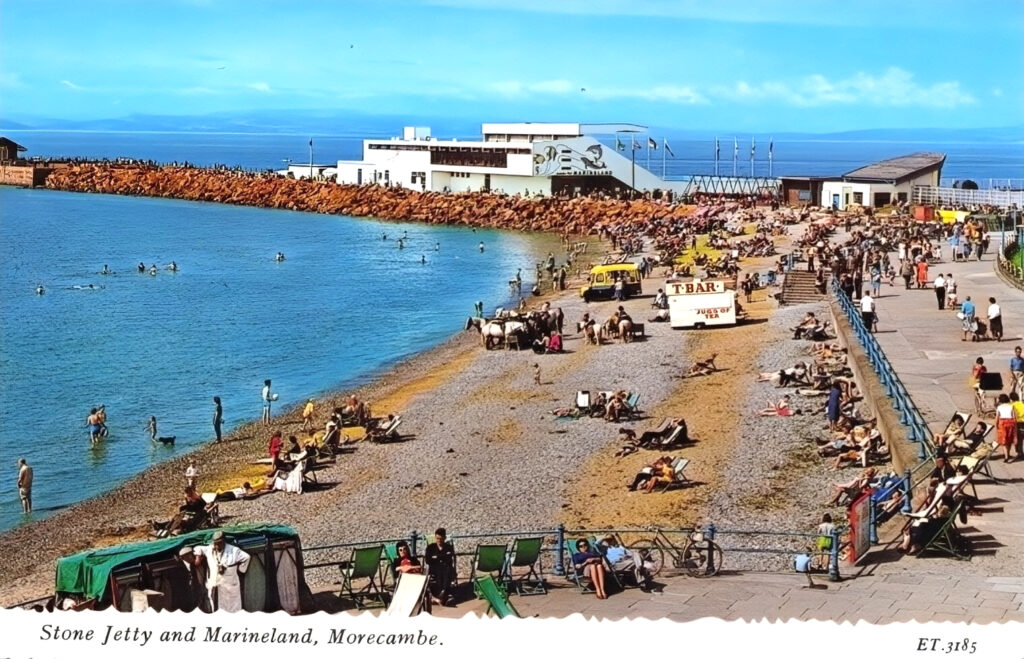
Marineland Morecambe was an ambitious scheme approved by the local council in 1962. Backed by Manchester-based developer Shearer Estates Ltd, the £160,000 project promised to deliver Europe’s first oceanarium to the resort. To secure the deal, the council entered into an unusual financial arrangement. Shearer Estates would finance the project and the operating company, Marineland (Morecambe) Ltd., would pay the council an annual rent of £8,000, which the council would then pass on to Shearer Estates. Crucially, the council guaranteed this payment for 30 years, regardless of whether Marineland kept up with its rent. At the end of that period, ownership of the building would automatically pass to the council.
However, the council’s decision to guarantee the payment quickly sparked controversy. Many local ratepayers were outraged, staging protests outside the council chambers with banners declaring “No guarantee for Marineland.” Critics argued that the deal placed an unfair financial burden on the town, while the council defended its position, insisting that ratepayers would not lose out in the long run since ownership of the building would eventually pass to the town at no extra cost.

The original vision for Marineland was far grander than what eventually emerged. Early plans featured a 3,000-seat arena and even a marine research laboratory, which was to be developed in partnership with Lancaster University. Day-to-day operations were to be overseen by three well-known animal specialists: Ken Denham, Robert Jackson (owner of the Welsh Mountain Zoo in Colwyn Bay), and the popular TV zoologist George Cansdale.
As the project developed, however, the plans were scaled back. The final design opted for a smaller, simpler building, with arena capacity reduced to just 900 seats. Not everyone was impressed. One letter to the local newspaper complained, “I cannot see that the designer has used a great deal of imagination… my wife thinks it looks like a set of modern toilets.”

Construction on Marineland began in August 1963. The ambitious new attraction was to include two outdoor tanks for dolphin shows, an indoor aquarium, and a stylish seafood restaurant called The Lobster Pot, which would be operated under lease by the Rank Organisation.
That same year, Marineland secured some of its earliest residents in rather controversial circumstances. In December 1963 the government authorised the culling of more than 300 grey seals on the Farne Islands off the coast of Northumberland, after salmon fishermen claimed the animals were depleting fish stocks and damaging their nets. Three of the seals—later named Isabel, Christine and Buster—were spared and temporarily housed at the Welsh Mountain Zoo until their transfer to Morecambe.
More animals arrived the following spring in dramatic fashion. On 20 May 1964 a specially chartered DC-7 aircraft landed at Ringway Airport, carrying what newspapers dubbed “The Flying Ark.” The 15-ton cargo included a 9-foot boa constrictor, 150 tropical fish, eight dolphins, seven turtles, sharks, raccoons, lizards, hawks, eagles and rattlesnakes. Even several palm trees, presented as a gift from the Mayor of Miami, were part of the shipment, adding to the exotic flavour of the new attraction.

The consignment of animals was divided between Marineland Morecambe and the Welsh Mountain Zoo. The dolphins, supplied by the Miami Seaquarium, made the transatlantic journey lying on foam mattresses, regularly sponged down and carefully turned over during the flight. Seaquarium staff accompanied them and stayed on in Morecambe to help oversee their acclimatisation. Once the aircraft landed, the animals were transported under police escort to the site, where their arrival created a media spectacle. All the major television stations and national newspapers reported on the event, ensuring Marineland opened in a blaze of publicity. Never one to miss a promotional opportunity, holiday camp magnate Fred Pontin even sent his private helicopter, laden with fresh fish, to help feed the new arrivals.
Behind the scenes, however, things were less smooth. Several animals died before the attraction even opened to the public, with rumours circulating of “heavy losses.” The site manager tried to downplay the situation, stating that the total value of deaths was no more than £150: “which might sound a lot but it’s a small figure when you think of the thousands of pounds of livestock we have here.” He added that some creatures had been dead on arrival, but insisted this had been expected—“in fact, we were surprised that there were not more casualties.”
Marineland Morecambe finally opened its doors to the public on 9 June 1964, with an official ceremony led by Captain Bill Gray of the Miami Seaquarium. Despite the early setbacks, the venture enjoyed a strong first season, drawing more than 200,000 visitors.


Early attractions at Marineland included penguins, flamingos, turtles, and five alligators imported from Mississippi, whose enclosure even featured a “tropical rainstorm” with sound effects. Chimpanzees were later added to the roster and became a popular draw, hosting daily tea parties for visitors.
But the building itself proved vulnerable to Morecambe’s harsh coastal weather. In January 1965 gale-force winds tore through the site, smashing windows, flooding the building, and even hurling a one-ton rock through a doorway. Four people were treated for injuries caused by flying glass. Another storm in September 1967 smashed every window on the west side, cutting off power and leaving 18 people trapped inside.
Despite such setbacks, things had initially seemed to be going well. It therefore came as a shock when, in September 1965, Marineland announced it was entering liquidation. Attendance figures had dropped sharply compared with the opening season, and the company could no longer sustain operations. In the immediate aftermath, four council officials volunteered their time to ensure the animals continued to be fed. By then, only three of the original eight dolphins were still alive.
There was brief hope when Pentland Hick, owner of Flamingo Park Zoo, expressed interest in taking over the facility, but he soon withdrew after finding the political situation surrounding Marineland too complicated. With no other bidders, the council reluctantly assumed control. A packed public meeting drew 350 residents, all voicing unanimous opposition to the idea. Nevertheless, with no alternatives, the takeover went ahead.
Following the council’s takeover, some of Marineland’s original staff were quickly moved aside. Curator Ken Denham offered to remain involved but was informed his services were no longer required, while the former general manager and accountant were also dismissed. Only Robert Jackson was retained, continuing in an advisory role until his untimely death in 1969.

In March 1966 the council attempted to cut costs by holding an auction of surplus items from the site. These included furniture, equipment, and even large stocks of unsold souvenirs from the gift shop. Further economies were made when the manager of the nearby swimming pool was given dual responsibility, being placed in charge of Marineland as well.

Around the same time, George Cansdale rejoined Shearer Estates for another ambitious scheme: the creation of a Marineland at Skegness. The first phase, an aquarium, was completed, but the project soon ran into financial difficulties and was eventually taken over by the local council. Plans for the second phase—a dolphin pool and arena—were never realised.
Back in Morecambe, the dolphin population was dwindling fast. By June 1966 only one remained from the original group. One had been sold, while six others had died—three of them after swallowing foreign objects. The last survivor, a dolphin named Smiley, died in November 1969.
Determined to keep the attraction alive, Marineland imported three replacements the following month. Caught “wild and untrained” in the Gulf of Mexico by Florida dolphin catcher Nevin Stewart, the new arrivals were flown to England but their plane was diverted to Heathrow, necessitating a long overland journey to Morecambe. Once there, they were named Hattie, Sadie and Rocky.

The Lobster Pot restaurant was closed by Rank at the end of 1966 due to a lack of custom not helped by the non-existent parking. It reopened in 1971 after the lease was transferred to local cafe owner Arthur Jevons.
The first official suggestion of animal cruelty was raised by Councillor Peacock at a 1974 council meeting after they’d authorised spending £8,000 buying two more dolphins from Panama. He said it was “callous” to keep these intelligent creatures in captivity. Someone else said dolphins “had better brains then we did” to which another member joked that “we should have some on the council”. Councillor Ball pointed out that “dolphins are an essential attraction at Marinerland and vital to the economy of the district”.

By the mid-1970s, Marineland Morecambe was still drawing around 150,000 visitors a year and was being promoted as “Britain’s Number 1 Aquarium.” Despite its popularity, the council reported that the complex was losing roughly £50,000 annually. The site’s collection included dolphins, sea lions, penguins, turtles, and alligators. One notable incident in 1976 captured public attention when the dolphin Rocky rescued a budgie that had fallen into his pool; the bird survived and made a full recovery.
After 11 years under council management, the complex was leased to the television and casino group Trident in 1978, a company that also owned Windsor Safari Park and Scarborough Zoo. In 1983 the lease passed to Ocean World (Marine) Ltd., who continued to operate Marineland until its closure.

By 1984 Rocky had become the last remaining dolphin at Marineland, accompanied only by a single sea lion. In August 1988, a 14-year-old female dolphin named Lady was acquired from Whipsnade Zoo in the hope the pair would breed. A few weeks later, both dolphins featured in an episode of Jim’ll Fix It. Despite annual attendance having dropped to around 80,000, the complex was still reported to be profitable.
Animal rights tensions escalated later that year. In September 1988, four members of the Animal Liberation Front were arrested while attempting to break into Marineland to release Rocky into the sea. Protests outside the site became increasingly common. In 1989 Lady became pregnant, but the calf was miscarried and Lady died shortly afterward from blood poisoning. Protesters staged a “funeral,” carrying dolphin-shaped coffins and wreaths.
Public opposition continued to grow. In 1990, a petition signed by 5,000 people was presented to the council during a stormy public meeting demanding Marineland’s closure. The Mail on Sunday launched a campaign to raise funds to release Rocky into the wild, eventually collecting over £120,000. A consortium of animal rights groups became involved, later facing accusations of spreading misinformation about the situation.
The site closed at the end of the 1990 season and in November, Rocky was moved to Flamingo Land after a breakdown of the water heater at Marineland Morecambe. Experts and scientists widely advised against releasing him into the wild, warning that after 20 years in captivity he would be unable to survive. Most believed he should spend his remaining years at Flamingo Land with three female dolphins. Independent vets also assessed that the 25-year-old dolphin was too old and unfit to travel.
Despite these warnings, Rocky was flown to the Caribbean, where he spent several months in a fenced-off lagoon. He was later joined by two dolphins from Brighton Aquarium, Missie and Silver. Eventually, all three were released into the wild, though their ultimate fate remains unknown.
The final animals were removed from Marineland in June 1991, finding new homes elsewhere. The building itself was demolished in February 1992, bringing an end to Morecambe’s once-celebrated oceanarium.

We’d love to hear your memories and stories of Marineland Morecambe. Please feel free to leave a comment below
